GENNA: Difference between revisions
we should explain why this name is used |
|||
| Line 1: | Line 1: | ||
Authors: {{PAGEAUTHORS}} | Authors: {{PAGEAUTHORS}} | ||
---- | ---- | ||
<sup>múl d</sup>GENNA (𒋼𒀭𒌉𒁹) = ''kayyamānu''(''m'') "Constant" is a common name for Saturn in cuneiform. It is the name that is used in the lists of 7 planets in the Late Babylonian Uranology tablet MCL 1866 and contemporary Late Babylonian ritual texts. The sign GENNA is the compound TUR.DIŠ''.'' | <sup>múl d</sup>GENNA (𒋼𒀭𒌉𒁹) = ''kayyamānu''(''m'') "Constant" is a common name for Saturn in cuneiform. It is the name that is used in the lists of 7 planets in the Late Babylonian Uranology tablet MCL 1866 and contemporary Late Babylonian ritual texts. The sign GENNA is the compound TUR.DIŠ''. We should explain why this name is used maybe???'' | ||
{{Template:Saturn}} | {{Template:Saturn}} | ||
Revision as of 09:03, 10 June 2026
Authors: Gennady E. Kurtik, Euin Choung Kim, David Hilder, Wayne Horowitz, Susanne M Hoffmann, Jan Safford, Youla Azkarrula
múl dGENNA (𒋼𒀭𒌉𒁹) = kayyamānu(m) "Constant" is a common name for Saturn in cuneiform. It is the name that is used in the lists of 7 planets in the Late Babylonian Uranology tablet MCL 1866 and contemporary Late Babylonian ritual texts. The sign GENNA is the compound TUR.DIŠ. We should explain why this name is used maybe???
Images of Saturn
-
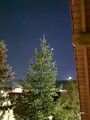 Saturn (uppest), Venus (next to the tree) and the Moon (at the horizon) at dusk in January 2025 (Susanne M Hoffmann).
 -
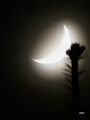 Saturn at the upper (dark) edge of the Moon on January 4, 2025, short before its occultation. It is obvious that Saturn is visible even with a slightly cloudy/ foggy sky.


Concordance, Etymology, History[1]
Var. reading:
- dTUR.DIŠ;
- = kayyamānu(m) "Constant"; The Sumerian equivalents of kayyamānu(m) mul/dSAG.UŠ and UDU.IDIM.SAG.UŠ (Kurtik s10, u09) are also commonly used in the first millennium BCE.
A designation of Saturn in astronomical texts of the first millennium BCE [Gössmann 69].
The name apparently comes from the Akkadian word, ginâ, "constantly, normally" [AHw, 289; CAD G, 78], close in meaning to kayyamānu, and apparently reflects the slow motion of Saturn relative to the stars in comparison to other planets.
| Sources | Identifications |
|---|---|
Lexical texts.
|
Example |
| EAE.
Only in later copies and commentaries, cf. [Rochberg-Halton 1988[2], 285, BM 47447 Rev. 29; SpTU I, 90:4-5, 7, 9; SpTU II, 42 r. 1, 6; SpTU III, 102 Rs. 8; SpTU IV, 162 r. 13]. |
|
| "Astronomical Diaries and Related Texts."
First in the diary for -567 as dGENNA [ADRT I, -567:9]; in the same diary we find dSAG.UŠ [ibid., -567:2]; in later texts the designation Saturn is always GENNA. |
|
Mathematical Astronomy.
|
|
Uranology
|
|
Late Astrology, Zodiacal Astrology.
|
Ritual Texts/ Miscellaneous
- (1) New Year ritual in Babylon: múlGENNA MUL kit-tu2 u mi-šar, "Saturn, the star of truth and justice". [RAcc. 138:307; Linssen 2004, 220:307].
- (2) Ritual in Uruk, see (Kurtik u07) UDU.IDIM.
Historical Dictionaries
| Kurtik (2022, g10) | Gössmann (1950) |
|---|---|
| вар. чтения: dTUR.DIŠ; = kayyamānu(m) «Постоянный»; обозначение Сатурна в астрономических текстах I тыс. до н.э. [G. 69]. Название происходит, по-видимому, от аккадского ginâ «постоянно, нормально» [AHw, 289; CAD G, 78], близкого по смыслу kayyamānu, и отражает, по-видимому, медленный характер движения Сатурна относительно звезд в сравнении с другими планетами. В астрологических текстах обычно употребляли названия SAG.UŠ, UDU.IDIM.SAG.UŠ (s10, u09).
I. Источники. Лексич. тексты. Нововавилонский комментарий: GENNA = ka-a-a-nu [AHw, 420]. ЕАЕ. Только в поздних копиях и комментариях, см. [ABCD, 285, BM 47447 Rev. 29; SpTU I, 90:4–5, 7, 9; SpTU II, 42 r. 1, 6; SpTU III, 102 Rs. 8; SpTU IV, 162 r. 13]. «Дневники наблюдений». Впервые в дневнике за -567 г. как dGENNA [ADRT I, -567:9]; в этом же дневнике встречаем dSAG.UŠ [ibid., -567:2], в более поздних текстах обозначение Сатурна всегда ― GENNA. Математическая астрономия. (d)GENNA ― обозначение Сатурна в эфемеридах селевкидского времени и гороскопах [ACT II, 474a; BH, 28]. Храмовые ритуалы. (1) Новогодний ритуал в Вавилоне: múlgenna mul kit-tu2 u mi-šar «Сатурн ― звезда суда и справедливости» [RAcc. 138:307; Linssen 2004, 220:307]. (2) Ритуал в Уруке, см. u07UDU.IDIM. Поздняя астрология. Зодиакальная астрология. a) aš2-šu2 dTUR.DIŠ lu […] ina KI SAL.MEŠ KI dSin DU-zu UŠ U3.TU «Поскольку Сатурн или [Марс] в области женщин стоит с Луной (или: на месте Луны): младенец мужского пола родится» [LBAT, 1593:7′–8′; Reiner 2000]. b) aš2-šu2 dTUR.DIŠ u dṢal-bat?-a?-nu? KI Sin / 2 UŠ(!).MEŠ U3.TU «Поскольку Сатурн и Марс? с [или: на месте] Луной (стоят): 2 (младенца мужского пола?) родятся» [LBAT, 1593:9′–10′; Reiner 2000]. с) Меркурий или Сатурн с Луной, см. g34GU4.UD. См. также mulGI6.NA (силлабическая запись GENNA?) [SpTU II, 42 r. 6]. См. также [SpTU V, 271:8ʹ]. |
Example |
References
- ↑ Planetarium Babylonicum 2.0, All Skies Encyclopaedia.
- ↑ Rochberg-Halton F. Aspect of Babylonian Celestial Divination: The Lunar Eclipse Tablets of Enuma Anu Enlil. Horn, 1988 (AfO, Beiheft 22).