al-Khibā' al-yamānī, al-Ḫibāʾ al-yamānī (الْخِبَاء اليماني)
Authors: Khalid Al-Ajaji
This article is about the asterism Alkhiba in the constellation Corvus. For the similarly named asterism in the northern sky, see Alkhiba alshamai (Northern Tent). For the star with a similar name, see Alchiba (the Tent).
Alkhiba (Arabic: الخباء, “the small tent”; also transliterated as al‑Ḫibāʾ and referred to as الْخِبَاء اليماني “Southern Tent”) is an asterism of four stars forming a quadrilateral in the constellation Corvus.
Headword
Arabic: الْخِبَاء اليماني Transliteration: al‑Ḫibāʾ al‑yamānī Romanization: al-Khibāʾ al-yamānī IPA: /ʔal.xɪ.baːʔu l.ja.maːniː/
Names
The asterism is referred to in historical sources as al-Khibāʾ (Arabic: الخباء, “the Tent”) without a specifier, and as “Southern Tent” (Arabic: الخباء اليماني, al-Khibāʾ al-yamānī). To avoid confusion with the asterism in Hercules also known as al-Khibāʾ and with the star α Crv named Alchiba, this article uses the form “Southern Tent” (Arabic: الخباء اليماني, al-Khibāʾ al-yamānī), following Ibn Qutayba.
The asterism is also called عجز الأسد (romanized: ʿajuz al-asad, “the Lion’s Hindquarters”), عرش السماك (romanized: ʿarsh al‑Simāk, literally “the Throne of al‑Simāk”; al‑Simāk is a proper name connected with being high or elevated) in works by Ibn Qutayba, al-Marzūqī, and al-Ṣūfī, while the form الأجمال/الأحمال (romanized: al-Ajmāl/al-Ahmāl, “the camels/the loads on camels”) is reported only by al‑Ṣūfī.
Modern Authors
Danielle Adams
Khalid AlAjaji
Etymology
al-Khibāʾ (Arabic: الخباء, from the Arabic root خبي) denotes a small tent. Lisān al-ʿArab defines al-Khibāʾ as:[1]
الخِباءُ مِنَ الأَبنية: وَاحِدُ الأَخْبية، وَهُوَ مَا كَانَ مِنْ وَبَر أَو صُوفٍ وَلَا يَكُونُ مِنْ شَعَر، وَهُوَ عَلَى عَمُودَيْنِ أَو ثَلَاثَةٍ، وَمَا فوقَ ذَلِكَ فَهُوَ بَيْت.
Al-Khibāʾ (الخِبَاء) is a tent made of camel wool or sheep’s wool, never of goat hair. It usually stands on two or three poles; anything larger than that is called a bayt (large tent).
Concordance
al-Khibāʾ al-yamānī is an asterism of the quadrilateral γ, ε, β, δ Crv in the constellation Corvus, corresponding to the brightest stars 2nd, 4th, 5th, and 7th of the 7 star Ptolemaic Corvus.
History
Three primary sources discuss the Arabic Southern Tent (الخِبَاء اليماني, al-Khibāʾ al-yamānī): Ibn Qutayba, al-Marzūqī, and al-Ṣūfī. Their accounts is mostly in agreement and lead to stars identifications with great confidence and to understanding how the Arabs imagined al-Khibāʾ as a sky figure.
-
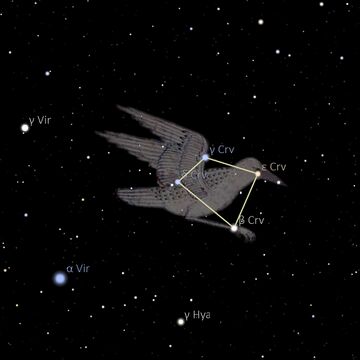 Southern Tent (الخباء اليماني), al-Khibāʾ al-yamānī in Corvus. Image produced by Stellarium. (CC BY Khalid AlAjaji 2026).
 -
 Arabian Khibāʾtent. image inspired by a century old photo in Matson collection in Library of Congress. (CC BY Khalid AlAjaji 2026).


Ibn Qutayba (d. 276 H / 889)
The complete text describing the Southern Tent (al-Khibāʾ al-yamānī) reads:[2]
- Original Arabic
قال ابن كناسة: وربما عدل القمر فنزل بعَجُزِ الأَسَدِ، وهي أربعة كواكب بين يدي السِّمَاكِ الأَعْزَلِ، منحدرة عنه في الجنوب، مربعة على صورة النَّعْشِ، يقال لها: عَرْشَ السِّمَاكِ، وتُسَمَّى: الخِبَاءَ.
- English translation
Ibn Kunāsa [d. 207H/822AD] said: "Sometimes the moon deviates and alights at the Hindquarters of the Lion ('Ajuz al-Asad). These are four stars situated before the Unarmed Simāk (al-Simāk al-A'zal), sloping down from it toward the south, squared in the shape of the stars of (Na'sh) [the bowl of the Big Dipper]; they are called the Throne of al-Simāk('Arsh al-Simāk) and are also named the Tent (al-Khibā')."
Ibn Qutayba also named this asterism the Southern tent (Arabic: الخباء اليماني، al-Khibāʾ alyamānī) in his description of the Northern Tent. The complete text reads:[3]
- Original Arabic
وأولاد الظباء كواكب صغار، فيما بين الظباء والنفزات، وعن يمين نفزات الظباء كواكب مستديرة غير متقارنة، تسمّى: الحوض. والخباء أسفل من الحوض، كواكب في مثل هيئة الخباء اليمانية.
- English translation
The fawns, awlād al-Zibāʾ (أَوْلادُ الظِّبَاءِ), are small stars located between al-Zibāʾ (الظِّبَاءِ) and the Gazelle Leaps (النَّفَزَاتِ). To the right of the Gazelle Leaps (نَفَزَاتِ الظِّبَاءِ), there are round, non-aligned stars called al-Hawd (الحَوْضَ, "the Pool"). Below al-Hawd lies al-Khibāʾ (الخِبَاءُ, "the Tent"), a group of stars shaped like the Southern tent (الخِبَاءِ اليَمَانِيَّةِ, al-Khibāʾ alyamāniyah).
Al-Ṣūfī (d. 376 H / 986)
The complete text describing the Southern Tent (al-Khibāʾ al-yamānī) reads:[4]
- Original Arabic
والعرب تُسَمِّي هذه الكواكب: عَجُزَ الأَسَدِ، وتزعم أن القمر ربما قصر فنزل بعجز الأسد، وتسمّيها أيضًا: عَرْشَ السِّمَاكِ الأَعْزَلِ، وتسميها أيضًا: الأَجْمَالَ، وتسميها أيضًا: الخِبَاءَ.
- English translation
The Arabs call these stars: the Hindquarters of the Lion (‘Ajuz al-Asad). They claim that the moon sometimes falls short and alights at the Hindquarters of the Lion. They also call them: the Throne of the Unarmed Simāk (‘Arsh al-Simāk al-A‘zal); they also call them: the Camels (al-Ajmāl); and they also call them: the Tent (al-Khibā’).
The name al-Ahmāl (Arabic الأحمال, the camel Loads) appeared in some manuscripts, but it seems to be a scribal error. both words shapes are similar with one dot difference الأجمال/الأحمال, while al-Ajmal (the camels) is preferred because it is in the same region as the Arabian constellations al-Sharāsīf (Arabic الشراسيف, the Tied camels) = (Hydra) and al-Ma'laf (Arabic المَعْلَف, the Camels feeding trough) = (Crater).
Al-Marzūqī (d. 421 H / 1030)
The complete text describing the Northern Tent (al-Ḫibāʾ ash-Šāmī) on the authority of Ibn al-Aʿrabī (d. 230 H / 845) reads:[5]
- Original Arabic
وقال [ابن الأعرابي]: أسفل من بَنَاتِ نَعْشٍ كواكب كثيرة مختلطة يقال لها: الضِّبَاعُ. وأَوْلَادُ الضِّبَاعِ كواكب صغار، عن يمين الضِّبَاعِ، بينها وبين بَنَاتِ نَعْشٍ. قال: والخِبَاءُ كواكب في مثل هيئة الخِبَاءِ، أسفل من أَوْلَادِ الضِّبَاعِ.
- English translation
[Ibn al-Aʿrabī] said: Below Banāt Naʿsh (بَنَاتِ نَعْش) are numerous, scattered stars called al-Ḍibāʿ (الضِّبَاعُ, "the hyenas"). Awlād al-Ḍibāʿ (أَوْلَادُ الضِّبَاعِ, "the young hyenas") are small stars located to the right of al-Ḍibāʿ, between them and Banāt Naʿsh. He also said: al-Ḫibāʾ (الخِبَاءُ) is a group of stars resembling the shape of a tent, situated below Awlād al-Ḍibāʿ (أَوْلَادُ الضِّبَاعِ, "the young hyenas").
-
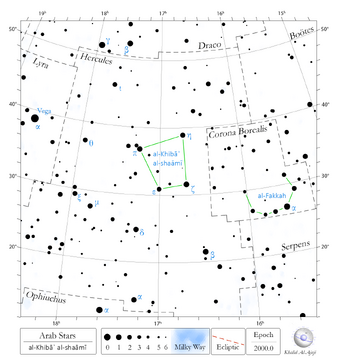 Star chart of the Arabian asterism al-Khiba al-shami (الخباء الشآمي) as described by al-Marzūqī in the area of Hercules constellation. (CC BY Khalid AlAjaji 2026).

Roland Laffitte
Weblinks
Reference
- ↑ Lisān al-ʿarab, لسان العرب، باب الواو والياء المعتل فصل الخاء المعجمة
- ↑ أبو محمد عبد الله بن مسلم ابن قتيبة الدينوري (توفي 276 هـ)، كتاب الأنواء في مواسم العرب، دائرة المعارف العثمانية، حيدر أباد، الهند، 1375 هـ، ص 62.
Ibn Qutayba al-Dīnawarī, Abū Muḥammad ʿAbdallah b. Muslim. 1956. Kitāb al-anwāʾ (fī mawāsim al-ʿArab). Hyderabad: Maṭbaʿat Majlis Dāʾirat al-Maʿārif al-ʿUthmāniyya, pg 62. - ↑ أبو محمد عبد الله بن مسلم ابن قتيبة الدينوري (توفي 276 هـ)، كتاب الأنواء في مواسم العرب، دائرة المعارف العثمانية، حيدر أباد، الهند، 1375 هـ، ص 67.
Ibn Qutayba al-Dīnawarī, Abū Muḥammad ʿAbdallah b. Muslim. 1956. Kitāb al-anwāʾ (fī mawāsim al-ʿArab). Hyderabad: Maṭbaʿat Majlis Dāʾirat al-Maʿārif al-ʿUthmāniyya, pg 67. - ↑ كتاب الكواكب لأبي الحسين عبد الرحمن بن عمر الرازي المعروف بالصوفي (291-376)، تحقيق خالد بن عبد الله العجاجي، ص 840.
Book of the stars by al-Ṣūfī (died 986): Critical edition with commentary by Khalid al-Ajaji, digital edition, 2021, pg 840. - ↑ الإمام أبو علي أحمد بن محمد بن الحسن المرزوقي (توفي سنة 421 هـ)، الأزمنة والأمكنة، تحقيق د. محمد نايف الدليمي، عالم الكتب، بيروت، لبنان، 1422 هـ، الجزء الثاني، ص 345.
Al-Marzūqī, Abū ʿAli Aḥmad b. Muḥammad b. al-Ḥassan (died 1030), Al-Azminah wa al-amkinah (Times and Places), Edition by Dr. Mohammad Nayef al-Dulaymi, (Arabic print of the original book in 2002, World of Books, Beirut, Lebanon), vol 2, pg 345.